Sections / Gems / Inputs and forms
Tumblers
A one-time-code input made like a combination lock. Each digit is a brass wheel: type and it spins a turn and clicks into place, backspace spins it back, drag a wheel to roll it by hand. While the code is empty the wheels idle a notch now and then. When every wheel is set the shackle springs open, or, if your check says no, the lock shakes and scrambles. A real input underneath, so paste and one-time-code autofill just work.
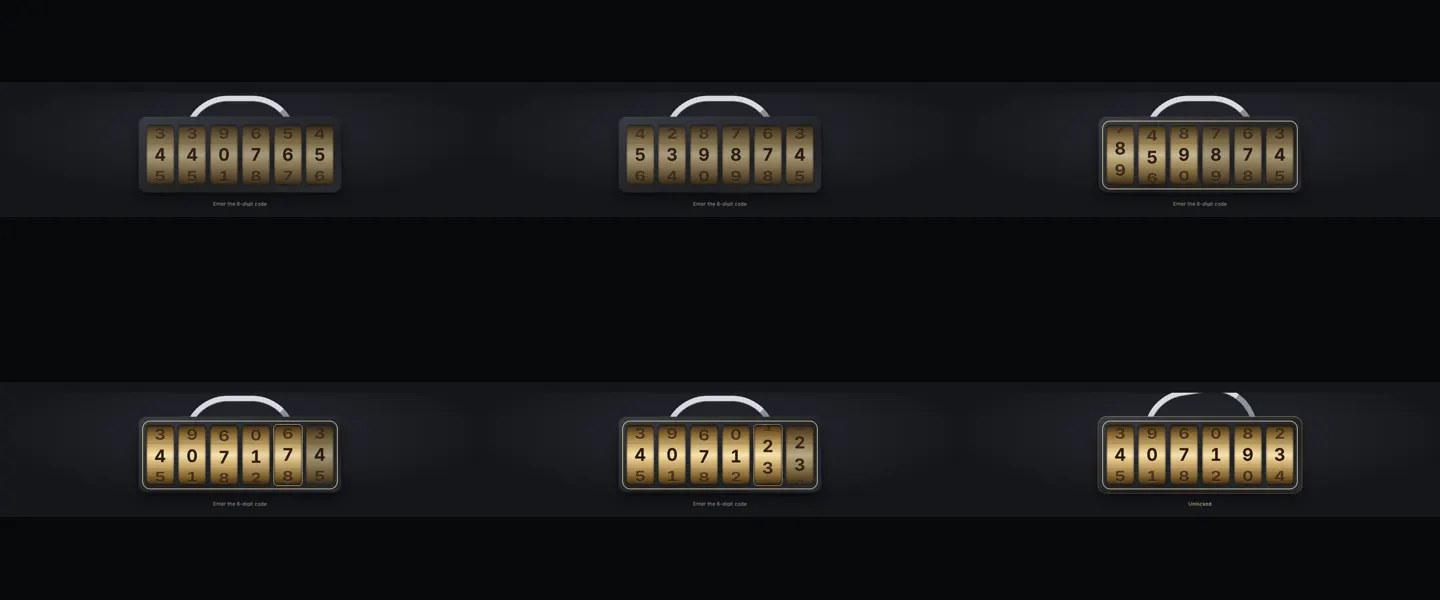
- Kind
- Inputs and forms
- Interaction
- code input · spinning wheels · drag to roll · paste and autofill · your check via callback · keyboard
- Dependencies
- None
- Licence
- Licensed with Full Access, for the sites you build; do not resell the gem itself
Formats
- Webflow (native)
- Figma (layers)
- Framer component
- HTML
- Prompts for Claude Code, Cursor, Lovable, v0, Bolt
Copy to Webflow pastes a native section with the gem in an Embed inside it. Copy to Figma pastes a frame of its best moment, text and controls as layers. Copy to Framer pastes a component with its options as controls. HTML is one self-contained snippet. Each prompt (Claude Code, Cursor, Lovable, v0, Bolt) carries the exact files, so your agent installs this gem, not a lookalike. With the MCP server, ask your agent for get_section("tumblers").
Behaviour and accessibility
- Type, paste or let the phone autofill the code: it goes into a real input with inputmode numeric and autocomplete one-time-code, labelled, and each wheel spins to its digit.
- Backspace spins a wheel back; the arrow keys roll the last digit up or down; status changes (open, wrong code) are announced politely.
- Drag a wheel up or down to roll it by hand (mouse, pen or touch).
- The idle fiddling runs only while the code is empty and the input is not focused; everything stops off screen or in a background tab.
- With prefers-reduced-motion: wheels jump to their digit, no idling, shaking or springing shackle.
Wire it to your model
Pass `verify(code)` returning true or false (or a promise of either), for example a fetch to your own endpoint that checks the code; without it, any full code opens the lock. `onComplete(code)` is called once it opens.
Options
| Option | Type | Default | What |
|---|---|---|---|
length | number | 6 | How many digits. |
label | string | "Verification code" | Accessible name of the input. |
hint | string | "Enter the 6-digit code" | The line under the lock while the code is incomplete. |
done | string | "Unlocked" | The line once it is open. |
wrong | string | "That code did not open it" | The line when your check says no. |
verify | (code: string) => boolean | Promise<boolean> | Your check: return true (or a promise of true) to open, false to shake and clear. Without one, any full code opens. | |
onComplete | (code: string) => void | Called with the code once the lock opens. | |
seed | number | 3 | Seed for the idle fiddling and the wheels' starting digits. |


 Free